Blowback, Second Edition: The Costs and Consequences of American Empire by Johnson Chalmers
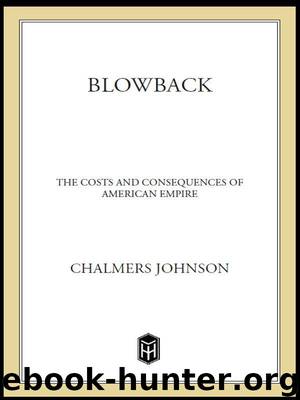
Author:Johnson, Chalmers [Johnson, Chalmers]
Language: eng
Format: mobi, epub
Publisher: Macmillan
Published: 2010-03-31T16:00:00+00:00
6
CHINA: THE STATE
OF THE REVOLUTION
On June 29, 1998, on a state visit to China, President Bill Clinton addressed the students of Beijing University in a speech carried live by television to all parts of China and then responded to their questions. One young man asked, “With a friendly smile, you have set foot on the soil of China. . . . So we are very excited and honored by your presence. What the Chinese people really aspire for is the friendship between China and the United States on the basis of equality. And I know that before your departure from the States, you said that the reason for you to visit China is because China is too important and engagement is better than containment. I’d like to ask you whether this is a kind of commitment you made for your visit, or do you have any other hidden things behind this smile? Do you have any other design to contain China?”1
This was a good question. Two years earlier the president had mobilized two carrier task forces when China launched a dramatic rocket barrage as part of its “military exercises” in the vicinity of Taiwan. These symbolic gestures were clearly aimed by the People’s Republic at the upcoming Taiwanese presidential elections, and were a response as well to an unprecedented visit by the Taiwanese president to the United States the previous year. The exercises were meant as reminders to both governments that the mainland would never look on Taiwan as anything other than a province of China, and the American response, equally symbolic and crude, was a sobering reminder to the Chinese of the massive military forces the United States maintains and is capable of deploying just off their coast. Ironically though, from the point of view of American policy goals, Clinton’s show of force had the unintended effect of helping the government in Beijing overcome its loss of legitimacy following the collapse of communism in Europe and its repression of its own students and workers in Tiananmen Square in 1989. Much as did Japanese aggression in the 1930s, American saber rattling rallied ordinary Chinese behind their government.
Since those aircraft carriers appeared in the waters off Taiwan in the spring of 1996, the United States has signed agreements with Japan enlarging the latter’s military commitments, undercutting its pacifist constitution, and securing its acquiescence in remaining a privileged sanctuary for American military operations. The issue of the territories and waters in East Asia covered by these agreements has been deliberately obscured: the U.S. government insists the area to be “protected” includes the Taiwan Strait, while the Japanese government insists it does not (and neither government has been candid with its citizens about the major ambiguities in the new agreements).
China has protested vigorously any intrusion by the United States and its Japanese client into Taiwanese affairs, but to no avail. The United States continues to sell arms to Taiwan in violation of agreements the Reagan administration signed with China during the 1980s (in the communiqué of August 17, 1982, the U.
Download
Blowback, Second Edition: The Costs and Consequences of American Empire by Johnson Chalmers.epub
This site does not store any files on its server. We only index and link to content provided by other sites. Please contact the content providers to delete copyright contents if any and email us, we'll remove relevant links or contents immediately.
| Anthropology | Archaeology |
| Philosophy | Politics & Government |
| Social Sciences | Sociology |
| Women's Studies |
The Secret History by Donna Tartt(18994)
The Social Justice Warrior Handbook by Lisa De Pasquale(12175)
Thirteen Reasons Why by Jay Asher(8871)
This Is How You Lose Her by Junot Diaz(6854)
Weapons of Math Destruction by Cathy O'Neil(6245)
Zero to One by Peter Thiel(5760)
Beartown by Fredrik Backman(5706)
The Myth of the Strong Leader by Archie Brown(5479)
The Fire Next Time by James Baldwin(5408)
How Democracies Die by Steven Levitsky & Daniel Ziblatt(5198)
Promise Me, Dad by Joe Biden(5127)
Stone's Rules by Roger Stone(5065)
A Higher Loyalty: Truth, Lies, and Leadership by James Comey(4937)
100 Deadly Skills by Clint Emerson(4898)
Rise and Kill First by Ronen Bergman(4757)
Secrecy World by Jake Bernstein(4724)
The David Icke Guide to the Global Conspiracy (and how to end it) by David Icke(4680)
The Farm by Tom Rob Smith(4484)
The Doomsday Machine by Daniel Ellsberg(4472)
